Loreto Publications

A Comparison of the Traditional and Novus Ordo Rites of the Seven Sacraments
by Daniel Graham
This book compares the texts of the Traditional rites and the Novus Ordo rites for the seven sacraments, so we can offer substantial reasons for choosing one rite over the other. The plan of the book is simple. For each sacrament, we describe patterns of changes in the texts; then, we lay the texts side by side with comments so you can see particular changes and see the patterns. Finally, we end the comparison of each sacrament by offering some conclusions.
Throughout this book, we use the term Traditional to distinguish the Roman Catholic rites before 1962. The authors of the rites promulgated after 1968 use the term Novus Ordo, translated New Order, to describe their new rites. An objective comparison of the texts clearly shows the differences. As St. Thomas Aquinas observed, "What is objectively real is objectively true." The differences in the two rites are objectively real.
Paperback, size 9" x 6", 220 pages

Cornelius a'Lapide's Commentary on St. Paul's Epistle to the Romans
Original translation from the Latin text of the Commentary of Cornelius aLapide on the Book of Romans by Michael Miller
This book starts with a 49 page introduction on St. Paul: his wisdom, style of writing, virtues, preaching, martyrdom, and miracles.
This is followed by aLapide's collected commentary on the book of Romans, chapter by chapter.
Included in the book is the Rheims New Testament text for the Letter to the Romans.
Sample Text:
WHO WAS St. PAUL?
WHAT KIND OF A MAN, AND HOW GREAT?
Eight gifts and extraordinary prerogatives should be considered and admired in S. Paul. First, his honourable descent and talent; second, his marvellous vocation and grace; third, his uncommon wisdom; fourth, his heroic virtues; fifth, his efficacious, fruitful evangelization; sixth, his illustrious martyrdom; seventh, his miracles, and eighth, his fame and glory.
Leather hardcover with satin ribbon, size 9.25" x 6.25", 528 pages

Thirty-Six Sketches
by Msgr Francis J Weber
Recently retired from over fifty years of service to God and to the people of the Archdiocese of Los Angeles, Monsignor Weber has allowed us to publish some of the delightful, insightful, and very succinct homilies he has given on real and literary characters found in the holy gospels.
The four gospels tell us the story of Jesus Christ, Son of God and Son of Man, the Savior of the world. In the course of those gospels, Jesus Christ tells us many stories that reveal God the Father’s loving plan for our salvation. Through the homilies collected here Monsignor Francis Weber does what a good preacher always does, that is, he points out the spiritual truth the gospels reveal, and then connects that truth with our own faith and daily experiences as disciples of Jesus Christ.
By “real characters” Monsignor Weber indicates the real life men and women whom Jesus met and engaged during his life and ministry, such as Peter and Paul and Pontius Pilate. “Literary characters” are the imaginary figures in Christ’s parables, such as the Prodigal Son and the Good Samaritan.
Contents include:
| Zachariah and Elizabeth | Sons of Thunder | The Prodigal Son | Judas Iscariot | Simon of Cyrene |
| The Magi | The Apostles | A Widow and Her Mite | John the Beloved | Dismas, The Good Thief |
| Simeon | Thomas the Doubter | Bartimaeus | A King and a Marriage Feast | Nicodemus |
| Mary | Rich Man and Lazarus | Good Samaritan | Joseph of Arimathea | Barrabas |
| John the Baptist | Young Man Whom Jesus Loved | Adulterous Woman | Mary Magdalen | |
| Peter, the Prince & Vicar | Peter and Paul | Mary, Mother of God | Herod Antipas | |
| The Householder | A Leper | Martha | Pontius Pilate | |
| Peter the Rock | Woman of the Streets | Zacchaeus | Veronica |
Paperback, size 8.5" x 5.5", 80 pages

by Hilaire Belloc
compiled by John Edward Dineen
Joseph Hilaire Pierre René Belloc, 1870-1953, was born in France of a French Catholic Father and an English protestant mother. His mother later converted under the influence of Cardinal Manning, a good friend and mentor of Hilaire. His only sister, Marie (Belloc) Lowndes, was a fairly well-known writer like her brother Hilaire. Belloc’s father died young, leaving his widow in dire financial straits with two young children to support. They moved to England, and they settled in Slindon, West Sussex, where Belloc lived for most of his life.
Belloc was a prolific writer and seldom was employed in any other remunerative endeavor during his life, hence the constancy of his precarious financial condition. However he was rarely, if ever, destitute, since he was one of the most widely read writers of the 20th century in both England and America. On this side of the Atlantic he is best known for his political, economic, and historical works. As an essayist he is less well-known, but some think that it is as a poet and essayist that his name will be longest remembered.
These twenty-five exquisite essays, selected by John Edward Dineen, were first published as a collection in 1936 and are here offered to a new generation of American readers to savor.
| The Inn of the Margeride | A Conversation with a Cat | On Thinking |
| The Men of the Desert | The Servants of the Rich | The Love of England |
| The Ebro Plain | On Living | The Griffin |
| The Return to England | The Sonnets of Milton | The Mowing of a Field |
| The Death of the Ship | On a Lost Manuscript | The Portrait of a Child |
| On Rest | On the Tears of the Great | The Good Woman |
| The Pleasant Place | Talking (and Singing) of the Nordic Man | On Translation |
| The Roman Road | A Chinese "Litany of Odd Numbers" | |
| On Inns | On the Approach of an Awful Doom |
Paperback, size 8" x 5", 245 pages

St. Paul's Epistle to Titus,
St. Paul's Epistle to Philemon
St. Paul's Epistle to Hebrews
Hebrews is one of Saint Paul's most important epistles and is theologically complex. Even though he was the Apostle to the Gentiles, he penned this for his Hebrew Christians in order to strengthen their knowledge and resolve in the face of persecution from their fellow unconverted Hebrews.
Titus was of Gentile and Greek descent on both sides and, if we are to believe Chrysostom in his first homily, came from Corinth. Hence the Apostle, writing the second time to the Corinthians, repeatedly mentions Titus, and used him as an administrator among his own people for collecting alms and other church matters. This Titus, having been converted to Christ and baptized by Paul, was one of his disciples. And he was an outstanding helper and interpreter in Paul’s preaching. Hence in 2 Corinthians 12:13 Paul calls Titus his brother.
Philemon, not a Jew but a Gentile, was a citizen of Colossus, a nobleman among his people, a remarkable man by his life, morals, and profession of the Christian faith. His house in Colossus still stood intact at the time of Theodoret, as he relates, and likewise that it started to be a church in S. Paul’s time, so that Paul might congregate the faithful there. Thus also, Archippus, the Bishop of the Colossians, lived there, as Paul implies in verse 2. this house, now dedicated to God as a Church, remained for many centuries.
Paul wrote this epistle in chains in Rome before the year 60 A.D., although he now hoped to be liberated from them shortly, as is clear from verse 22. He sent this Epistle through Onesimus himself together with the Epistle to the Colossians.
Hebrews
Paul here proposes and proves to the Hebrews: First, the divinity and dignity of Christ; Second, that his priesthood, i.e., Christ’s once-and-for-all sacrifice on the cross foreshadowed by all the old sacrifices, was alone sufficient to accomplish the redemption of us all; Third, he shows that Christ’s office was to be the expiator of all sins by His own blood, our redeemer, mediator, and pontiff who opens the gates of Heaven; Fourth, he shows the difference of the New Testament and its superiority over the Old; Fifth, he consoles those who were despoiled as apostates and harassed in various ways by the Jewish authorities, with the permission of their Roman overlords, on account of their faith in Christ and their defection from the law of Moses. Indeed, if we are to believe S. Chrysostom, the purpose of the entire Epistle is to console and strengthen these same Christians. Finally, as was Paul’s custom, he concludes the Epistle with moral instruction and ethical precepts.
Leather hardcover with satin ribbon, size 9.25" x 6.25", 498 pages

The complete and unabridged commentary of Cornelius a Lapidé on the Catholic Epistles of Saints John and Jude
Cornelius a Lapide created a Scripture Commentary so complete and scholarly that it was practically the universal commentary in use by Catholics (often available only in around 30 Latin volumes) for hundreds of years.
This set boasts the following features:
- Leather Covers & Satin Ribbons
- Never Fully Translated Before
- Sewn Binding & Headbands
- Extensive discussion of Greek & Hebrew word meanings

Catholic Principles Abandoned at the Reformation
by Right Rev. Francis Aidan Gasquet, Abbot-General of the English Benedictines
In these days when there is a strong movement afoot without the fold to restore the unity of the Christian Faith, we can indulge the hope that the four lectures of the distinguished abbot will prove fruitful. They are on subjects so vital to unity, i.e., the supremacy of the pope, the sacrifice of the Mass, the eternal priesthood, the universal Church. We pray that these sermons will attract the attention of many outside the Church, and make them meditate on the bitterness of breaking from their “Father's House”. May God's holy grace prove stronger than prejudice, as it has so often in the past, and may it soften the hearts which have been hardened by cruel legislation rather than by wilfull disobedience.
PREFACE
The Right Rev. Francis Aidan Gasquet, Abbot-General of the English Benedictines and Chairman of the Commission appointed for the revision of the Vulgate or Latin Bible, gave a course of sermons at the High Mass in St. Patrick's Cathedral on the Sundays of Advent, 1913, on “Catholic Principles Abandoned at the Reformation”.
These sermons attracted very wide attention. The subject chosen, while seemingly a familiar one, proved most interesting to the vast congregations, drawn by the fame of the preacher as an historian of the Reformation period. His manner of treatment had much to do with the profound interest manifested by his listeners.
All attempt at pulpit oratory was cast aside, and the preacher confined himself to a clear unvarnished tale of the causes that led up to the so-called Reformation. He showed himself a complete master of the question. As announced in his opening sermon, the Rt. Rev. Abbot did not seek to be controversial, but purely historical, and this purpose he followed to the end, basing all his statements on documents whose authenticity could not be called into question. He made clear what Cardinal Manning has so often repeated, that England did not give up the Catholic Faith of centuries, but was simply robbed of it.
It was my pleasure to be present at all the sermons, and to be held under the spell of his simple eloquence, and to experience the appeal his strong arguments must have made. The main thesis which the learned abbot sought to establish was that the doctrines of the Church in England had been reconstructed under Lutheran and Calvinistic influence, and the central beliefs held by the Church from the time of Christ had been rejected. This was especially true of the priesthood. By Act of Parliament, a new form of ordination, carefully and systematically excluding every word that could be interpreted to mean that the candidate was to be a sacrificing priest, was introduced.
In these days when there is a strong movement afoot without the fold to restore the unity of the Christian Faith, we can indulge the hope that the four lectures of the distinguished abbot will prove fruitful. They are on subjects so vital to unity, i.e., the supremacy of the pope, the sacrifice of the Mass, the eternal priesthood, the universal Church. We pray that these sermons will attract the attention of many outside the Church, and make them meditate on the bitterness of breaking from their “Father's House”. May God's holy grace prove stronger than prejudice, as it has so often in the past, and may it soften the hearts which have been hardened by cruel legislation rather than by wilful disobedience.
† JOHN CARDINAL FARLEY,
Archbishop of New York.
New York,
The Feast of St. Thomas the Apostle, 1913
Booklet, size 8.5" x 5.2", 36 pages

by Fr Denis Fahey, C.S.Sp
Mental prayer is, in a certain sense, the most important exercise of the spiritual life. Fidelity to it (saints tell us) will ensure salvation; its complete abandonment may lead to perdition; progress therein means a corresponding progress in the interior life of union with God. Hence, the special value of books which treat of mental prayer. The excellence of the present work lies in the source from which it is drawn. St. Thomas Aquinas holds a unique place among the Doctors of the Church. He has become the official theologian of Christ s Mystical Spouse, her Universal Doctor. She has canonized his teaching, making it her own in all its essential elements.
This is the first of Fr. Fahey's books to be published, and it remains one of his most important for it presents the foundation of his spiritual life of prayer that was so fruitful.
Paperback, size 8.5" x 5.5", 58 pages

by Frances Carpenter
Frances Aretta Carpenter (April 30, 1890 – November 2, 1972) was an American folklorist, author, and photographer. She traveled to, and published collections of folk stories from, nations on five continents.
This is one of a series of five ‘Grandmother tales’ published by Frances Carpenter in the 1930s and 40s. They were very popular in their time, and they have proved their enduring value to several generations of American children since then.
The author spent years researching and preparing these collections of some of the most culturally significant and typical tales from the oral traditions of several nations. Delightfully illustrated and typeset, these stories are perfect for reading to the children by the fireside or after the family’s evening meal or prayers.
Paperback, size 8.5" x 5.5", 278 pages, Illustrated in Colour and Black & White

edited by Daniel M. Clough, M.A.
This book is compiled according to the magnificent pattern established by Thomas Aquinas in the Catena Aurea. It is a well researched and thoughtfully composed listing of the Commentary of the saints and Fathers and Doctors of the Church who have written of the first three chapters of Genesis. Unlike aLapide, there is no commentary or analysis of the scripture from the compiler himself but it is a remarkably well done listing of what has been written by the greatest of commentators themselves and although there are some differences of opinion among the saint's writings here, yet, the whole of their accumulated commentary presents a remarkably unified picture of the 'mind of the Church' from the earliest times through the centuries on the first (and arguably most important) three chapters of God's Words to men.
Man is a contingent and limited being with a fallen nature, yet, because he is made in the image and likeness of God, his aspirations to knowledge are limitless since, once created, the duration of his being is endless. Man’s nature is seeking perfection in both knowledge and in being that can only be found in union with that which is not contingent or limited in any fashion—God.
Religion is the knowledge that man seeks, but which he cannot discover on his own. True religion rests upon one thing, God’s authority, and is revealed to men by three methods, Creation, Tradition and Scripture.
Daniel Clough compiles in this volume the teachings of the Fathers and Doctors of the Church of God on all three things:
Tradition, Scripture, and Creation. Here are the deepest thoughts of the greatest saints and scholars on the origins and ends (the Alpha and the Omega) of the world.
In the beginning God created heaven and earth.
In the beginning was the Word, and the Word was with God, and the Word was God.
In these two statements from God lie the origins, the genesis, of all knowledge that the heart of man desires. This series of commentaries on the first three chapters of the book of Genesis is the place to begin our profound inquiry into that knowledge that will be completed, God
willing, in the beatific vision.
Paperback, size 8.5" x 5.5", 264 pages

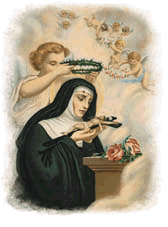
Saint Margaret of Hungary: A Tale of Vows and Sanctity
by E. Virginia Newell
St. Margaret of Hungary, OP (Margit in Hungarian; January 27, 1242 – January 18, 1270) was a Dominican nun and the daughter of King Béla IV of Hungary and Maria Laskarina. The 8th child of ten, she was the younger sister of St. Kinga of Poland (Kunegunda) and St. Yolanda of Poland and, through her father, the niece of the famed St. Elizabeth of Hungary. She was a member of the illustrious Arpad family who gave many great rulers and saints to the world over 300 years. Among them are the famous King St. Stephen crowned in 1000 AD as well as St. Irene, and two other St. Elizabeths.
Margaret was born during the Mongol invasion of Hungary (1241–42). Her parents vowed that if Hungary was liberated from the Mongols, they would dedicate the child to religion. The three year old Margaret was entrusted by her parents to the Dominican monastery at Veszprém in 1245. Six years later she was transferred to the Monastery of the Blessed Virgin founded by her parents on Nyulak Szigete (Rabbit Island) near Buda (today Margaret Island, named after her, and a part of Budapest; the ruins of the monastery can still be seen). She spent the rest of her life there, dedicating herself to religion and opposing all attempts of her father to arrange a political marriage for her with King Ottokar II of Bohemia.
She lived in total humility, engaging in the most menial tasks even in the winter when her hands bled from the cold. She constantly fasted and refused nice clothes and royal comforts, remarking that she preferred the odor of sanctity when dead to smelling sweet only when alive. She spent her days in prayer, in devotion to the Eucharist, and caring for the poor, lavishing on them whatever gifts her royal family sent her.
This is her story.
Paperback, size 7" x 5.25", 80 pages, illustrated

by Fr Denis Fahey, C.S.Sp
Written in 1932, and just as pertinent today, Fr. Fahey explains the doctrine of Christ the King, and His rights in and over societies and nations, based upon the teaching of the Church, and in particular the Encyclical Quas Primas. Scripture tells us that "every knee shall bow and every tongue confess that Jesus Christ is Lord." Christ is not just King of Heaven, He is also King of the Earth, and desires that man establish his societies and nations under His benign rule. Fr. Fahey describes to us what this ideal State should look like, as it follows the program of Christ, as opposed to that of Satan and "organized naturalism."
If one were to state succinctly the predominant supposition that underlies all modern thinking and action regarding human societies it would be that God has no absolute rights over the laws and governments of men; that men are sovereign over their own lives both individually and collectively.
This is the antithesis of reality. It is the devil’s doctrine. “You shall not die the death.You shall be as Gods!” This was the first lie and it is still the most destructive. Belief in that lie is almost universal today, both in thought and in practice.
God is the Creator, Sustainer, Redeemer, Savior, and Sanctifier of all men. All men belong to God and we owe him our love and obedience in every aspect of our lives. Jesus Christ the God-Man is our King by every conceivable right and title, both human and divine. He has the RIGHT to be obeyed and honored by all human societies, especially governments. The Rights of Man are all subject to those of Christ the King, and all so-called ‘human rights’ will disappear if God’s rights are not properly honored by society.
Paperback, size 8.5" x 5.5", 125 pages

In Latin and English
Here you will find all of the essential documents and infallible teachings of these two modern councils of the Catholic Church. They are beautifully laid out in a two-column format with large readable fonts of both the original Latin and Cardinal Manning's English translation side by side.
Paperback, size 9" x 6", 170 pages

by Br. Charles Madden OFM, Conv.
56 years of marriage and 11 children. The Maddens of Baltimore will surprise you, comfort you, make you laugh until you cry, and make you cry until you laugh again! From games of “pitch” to petty thievery, from over-zealous confessions to exacerbating obedience, there is truly never a dull moment!
But these true stories about a real family, as told by the youngest brother, are much more than just a collection of humor. Together, they weave a tapestry about family life—the way it should be lived and enjoyed. The virtues and the vices, the laughter and the frustration, the happiness and the mourning, the prosperity and the poverty: the family is the first school of love.
Paperback, size 8.25" x 5.25", 111 pages

by Fanchon Royer
Miguel Pro was born in 1891. He was the third of eleven children, four of whom had died as infants or young children. He entered the Jesuit novitiate at El Llano on August 15, 1911, was ordained in 1925, and executed in 1927. In 1952—just 25 years later—his cause came up for beatification and he was beatified by Pope John Paul II on September 25, 1988.
At the time of Padre Pro’s death, Mexico was under rule of the fiercely anti-clerical and anti-Catholic President Plutarch Elias Calles who had begun what writer Graham Greene called the “fiercest persecution of religion anywhere since the reign of Elizabeth.” During those years of the Masonic-Communist persecution, the Mexican people rose up in a great war to defend their nation and the rights of the Church and of Christ the King. Their battle-cry was Viva Christo Rey! Blessed Padre Pro’s martyrdom came at the height of the war and it typifies the period of the Cristero rebellion and its heroes. He took no part in the war, but spent his life ministering to the poor and faithful Mexicans.He was one of the earliest combatants of communism and a pioneer “priest worker.” While observing the Mexican miners’ needs as assistant to his father, a mine operator, he first recognized his vocation. After entering the Society of Jesus, and spending time in Belgium and Spain for studies, he fell into the company of priests and seminarians who were preparing the way for the apostolate to the worker. When he returned to Mexico at the height of the anti-Catholic persecution, his was a mission to the laborers and to the poorest Mexicans.
Disguised in overalls or chauffeur’s gear, he made his unwearied rounds bringing the sacraments and succour for body and soul to countless people. Heroic acts of charity and breath-taking escapes were his daily life. With the police ever on his trail, he daily brought solace and material aid to his persecuted compatriots. That this continued for only two years is not surprising: every day of survival during these two years was a miracle.
Fanchón Royer has explored every possible source of information including official records of the Society of Jesus, documents and newspaper files, first-hand memoranda of the Pro family, and Father Pro’s correspondence. Mrs. Royer draws the portrait of an unusual and winning personality whose love of fun, mimicry, music, and poetry never left him during his hazardous and soul searing adventures. Her rich background in Latin-American history and long, intimate acquaintance with the Mexican mind and temperament add greatly to the dramatic power of her narrative.
Paperback, size 8" x 5.25", 304 pages

The Spiritual Life of Cardinal Merry del Val
by Rev. Jerome DalGal
In the early part of the 21st century, because of the incessant and often strident media attention to the doings and mis-doings of many highly placed Churchmen, it is good to reflect upon how much good can be accomplished for the greater glory of God and the advancement of religion by even one man of deep holiness who has been placed in a position of great authority and responsibility in the Church.
Such a man was Cardinal Merry del Val. He was born into an aristocratic family of Irish, English, and Spanish parentage (oh happy combination!) in the city of London. His parents were the Marquis Raphael Merry del Val and the Countess Josephine de Zuletta. Among the family of his forebears was a martyr of the Church, St. Domenguito del Val, a child of barely seven who was crucified to a wall in the Cathedral of Saragossa in 1250 by the enemies of Christianity. He is of course best known as the architect and executor of St. Pius X’s war against Modernism, for which great service to God he acquired numerous enemies in his lifetime, and for which we can be sure that he gained many friends in Heaven. But his life was not one of merely temporal greatness. He was a profoundly humble and virtuous man as well.
Saint Pius X had as his Secretary of State a man who was eminently worth of his holy pontificate—Cardinal Merry del Val. In 1931, a year after the death of this illustrious Cardinal, the famous French scholar René Bazin made he following observation: “Judgment was passed in many different ways on Cardinal Merry del Val while he was living. This was due largely to the part he played in the political and religious affairs of his time. But now that he is dead people are getting to know him better, for with death has come the unveiling of the well-guarded secret of his extraordinary spiritual life.”
Paperback, size 8.5" x 5.5", 178 pages

by Fr Denis Fahey, C.S.Sp
Originally published in 1945, just eight years before his death, this is Fr. Fahey s magnum opus. All of his written work is centered around the Kingship of Christ and his right to rule over all human societies and governments. Just as we daily pray that God s will be done ON EARTH as it is in heaven, it follows that all human works, especially the government of all of our human societies (the family, the state, the Church in her human aspects) must conform to God s will and not He to ours.
This book details the Rights of God in human governments. He has the RIGHT to be obeyed, even by the state. This book proposes the RE-organization of society according to God s will for us on earth and within the context of the Mystical Body of Christ. Human governments will only be as good as they can be in this fallen world insofar as they conform to God s Divine Plan for Order in establishing and running society. Here is that plan as laid out by God and his Church and explained by Fr. Fahey. Only when man puts God s Rights first, will there be any hope of Human Rights being respected or upheld.
Paperback, size 8.5" x 5.5", 822 pages

For Daily Mass
Reproduction of the 1958 Marian Missal with Latin/English text for the Introit, Gradual/Tract, Offertory and Communion prayers and for the Ordinary of the Mass.
Includes the revised Holy Week and Easter Vigil Liturgy, table of Moveable Feasts to the year 2040, the Ordinary in large bold print with rubrics in Red, various prayers, litanies and devotions.
Soft flexible cover, size 6.75" x 4.25", 1450 pages

The Kingship Christ and the Conversion of the Jewish Nation
by Fr. Denis Fahey C.S.Sp.
“I repeatedly promised Saint Peter that if I ever got the chance, I would teach the truth about his Master in the way he and his successors, the Roman Pontiffs, wanted it done. That is what I have striven to do and am doing.” — Rev. Denis Fahey
No man is wise who does not think correctly about the Jews. On this subject it is very easy to be wrong, and there are many different varieties of errors into which to fall. They are a unique type of collectivity—a matter for history, not for sociology.
Their election in the Old Testament, which we must accept on faith, is at least as mysterious as their rejection in the New Testament. The Jews are willing to take the first part of the bargain, which they did not deserve, but not the second, which they did. Ever since the moment of the Crucifixion, the Jews are engaged in a mystical war against the Church, but they are only effective when the Faith is weak.
A true, firm, and unsentimental understanding of the Jewish problem is absolutely necessary for one who must protect the Faith and the faithful. The higher the responsibility, the greater the necessity.
Fr. Fahey begs us to pray for the Conversion of the Jewish nation, but he teaches us to prudently study and to wisely understand reality in their regard.
Paperback, size 8.5" x 5.5", 200 pages

by Fr Denis Fahey, C.S.Sp
This is the last book published before Fr. Fahey's death. It is an enduring testament to his love of the land and his firm belief that the best setting for most Catholic living is the family farm or small business, similar to the life lived by the Holy Family of Nazareth.
The Church is greatly interested in farming because it is the most fundamental of all human occupations. Those who work the land are deeply immersed in, and must work in harmony with, the natural rhythms and processes of God s creative handiwork. The harmony and balance of rural life are profoundly upset by industrialized living, both on and off the land. Father delves into many spiritual, chemical, technical, and scientific questions pertaining to the future of farming and the life of the Church and all human society, which depends completely on the land for its existence and prosperity.
Paperback, size 8.5" x 5.5", 226 pages